 Seldon
The one K-beauty route that has actually been proven
Last updated
#K-beauty#viral seeding#Amazon Prime Day#category ranking#market entry#content commerce#distributors
Every few months someone declares that K-beauty has cracked global commerce. What actually got cracked is narrower than that, and more useful. One route was run end to end, in one market, and it worked. Everything else people credit — formulation, price, packaging, the word "Korean" itself — has been true for two decades without producing this.
I have spent nineteen years in commerce and the last several watching brands try to buy their way into markets where nobody knows them. The K-beauty brands that broke out in the United States did not out-market anyone. They ran the same five steps in the same order.
What has K-beauty actually proven?
That one route works, not that Korean beauty is unbeatable. The proven thing is a sequence: seed content until the category notices, land the resulting demand on a retail event, convert that spike into a category ranking, and let the ranking pull local distributors into buying stock.
The market data behind it is not ambiguous. In the first nine months of 2025 the United States took USD 1.67 billion of Korean cosmetics exports, 19.6% of the total, passing China's USD 1.58 billion — a market that had been 52.9% of the total as recently as 2021 and was down to 18.6%. The centre of gravity moved, and it moved to the market where this route was being run.
What is the route?
Five steps, and the order is not negotiable.
| # | Step | What it produces |
|---|---|---|
| 1 | Enter the US market | A content-commerce environment where discovery is not gated by shelf space |
| 2 | Load viral seeding | Enough similar content that the platform reads a trend, not a campaign |
| 3 | Align to a retail event | Demand arrives on a day when traffic is already there |
| 4 | Take the category ranking | A position that keeps selling after the spend stops |
| 5 | Trigger local vendor buy-in | Distributors purchase stock. This is where the money is |
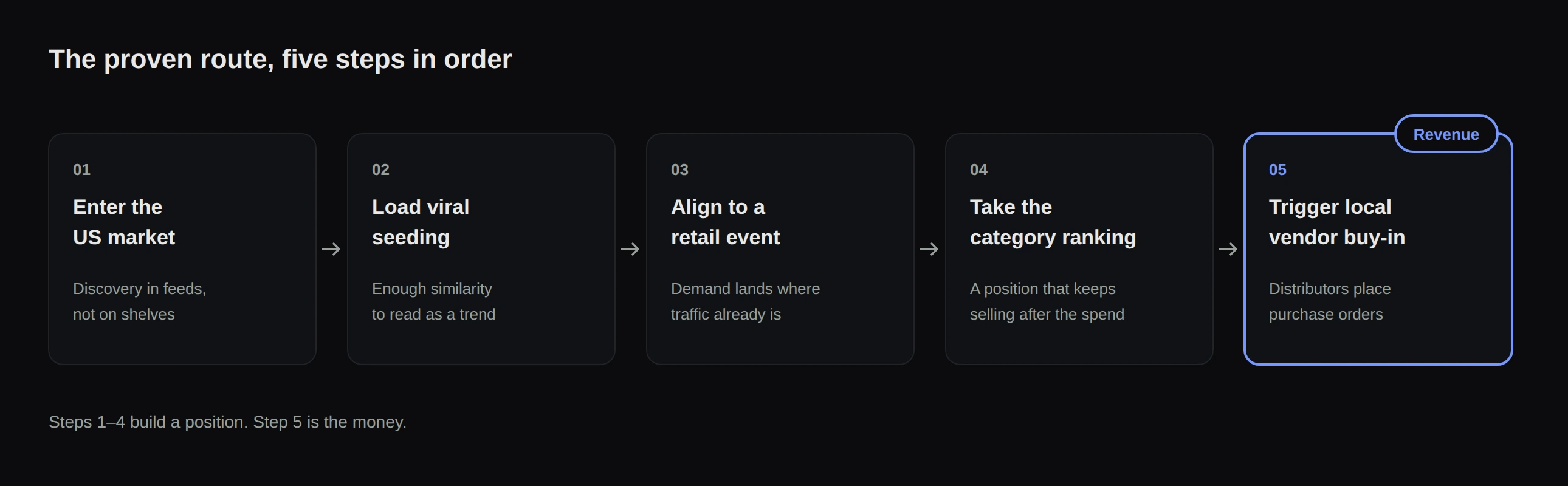
Step 3 is the one most brands treat as scheduling and it is not. Amazon Prime Day is the clearest version: a fixed date when purchase intent is already elevated across the whole platform. Seeding that peaks two weeks before it wastes the peak. Seeding that peaks into it converts.
The results are visible in the rankings. During the June 2026 Prime Day, Korean brands made up close to 40% of the top 100 skincare products, and the top two products in Amazon's entire beauty and personal care ranking were Medicube's Zero Pore Pads and Biodance's Bio-Collagen Real Deep Mask.
Why does the money show up at the last step?
Because the first four steps buy a position, and a position is what distributors buy against.
Direct-to-consumer sales during a campaign are real but bounded by what you can spend. A local vendor placing a purchase order is not. When a product sits at the top of a category ranking, the buyer's risk calculation changes — they are not betting on a brand, they are buying something already selling in their market. That order is a different order of magnitude from what the campaign itself moved.
This is also why brands that stop at step 4 report a successful campaign and a disappointing quarter. The ranking was never the outcome. It was the argument.
Does the route travel?
It already has. Not as a forecast — as customs data.
In the first half of 2026, Korean cosmetics exports to Europe reached USD 1.596 billion, passing North America's USD 1.570 billion for the first time. Europe went from USD 1.09 billion in 2023 to 1.41 billion in 2024 to 2.05 billion in 2025. Latin America and parts of APAC are moving on a similar curve behind it.
Five conditions carry the route across a border, and each maps to one step.
| Step | What has to exist locally |
|---|---|
| Market | Content commerce — discovery happening in feeds rather than on shelves |
| Seeding | Content that is not culture-bound. If the demonstration survives translation, the campaign replicates |
| Event | A dated demand spike. Prime Day where it exists, a local marketplace equivalent where it does not |
| Ranking | A visible ranking surface, or any placement buyers actually look at |
| Buy-in | Distributors who purchase rather than consign |
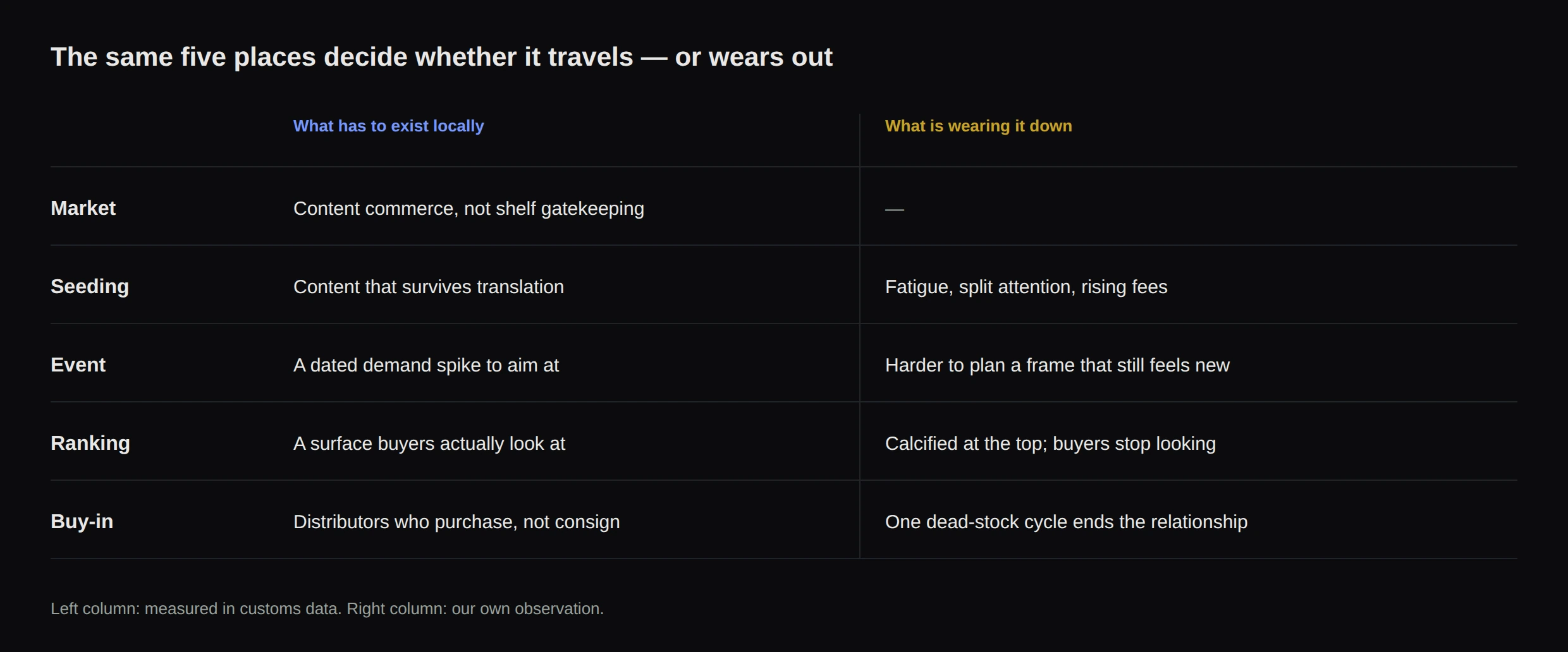
Seeding is the step that travels best, and that is the part most people miss. A product demonstration that works without language — texture, before and after, a thing visibly happening on skin — reproduces in any market with the same frame and different faces. That is not a translation problem. It is the same campaign.
What is wearing the route down?
Everything above is the argument for running it. Here is the argument against, and it is getting stronger. These are our own observations from running campaigns through this period, not published figures.
Everyone is seeding now. Consumer fatigue is up, creator attention is split across more brands, and creator fees have risen. The same campaign returns less than it did.
The planning bar has moved. When seeding was rare, a competent frame was enough. Now the audience has seen the format, and a frame that would have carried a campaign two years ago reads as an ad.
There is a budget floor, and it rose with the fees. Below a certain spend you cannot assemble enough similar creators to make a cluster, and a scatter of posts is not a trend. You end up paying inflated channel prices for content that never reaches the mechanism.
Rankings are calcifying. The top of the category is increasingly held by brands that already won, and we are seeing buyers stop treating those screens as a discovery tool. When the ranking stops being a signal, step 4 stops paying for step 5.
The dead stock problem
One bad inventory cycle ends the relationship. A distributor buys on the strength of a campaign, the brand shifts strategy, support drops, and the stock ages on their books. That vendor does not place a second order — and in most markets there are not many vendors. This is the quietest of the five and the one that has ended the most promising accounts we have watched.
Is the route dead, then?
No. It is crowded, which is a different problem with a different answer.
A crowded route punishes weak execution far harder than an empty one did. The brands still clearing it are not spending more; they are timing better, briefing tighter, and treating the vendor relationship as a supply commitment rather than a win. The three earlier pieces on this site — what seeded views actually cost, how often a piece breaks a million views, what proportion of creators accept a proposal — are all measurements of step 2 under exactly this pressure.
What should a brand entering a market now take from this?
Pick the market by whether the five conditions exist, not by market size. A smaller market with content commerce, a dated event, a ranking surface and buying distributors will out-return a larger one missing two of them.
Then run the steps in order and resist the temptation to skip to four. Ranking bought without a seeding base underneath it decays the moment the spend stops, and the buyers who matter can tell the difference.
And plan the fifth step before the first. Vendor buy-in is the payoff, which means the marketing plan has to survive contact with someone else's inventory. Decide now what you will do for that distributor in the six months after the order lands, because that decision — not the campaign — determines whether there is a second one.
Questions people ask
What is the K-beauty global expansion strategy?
A five-step route proven in the United States: enter a content-commerce market, load viral seeding until the content reads as a trend, align the resulting demand to a retail event such as Amazon Prime Day, convert that spike into a category ranking, and let the ranking trigger local vendor buy-in.
Why did K-beauty succeed in the US market?
Because discovery there happens in feeds rather than on shelves, which lets seeded content reach a category without shelf space. In the first nine months of 2025 the US took 19.6% of Korean cosmetics exports, passing China, which had been 52.9% of the total in 2021.
Can the same strategy work outside the United States?
Where five conditions exist: content commerce, content that survives translation, a dated demand spike, a ranking surface buyers look at, and distributors who purchase rather than consign. Korean exports to Europe reached USD 1.596 billion in the first half of 2026, passing North America's USD 1.570 billion.
Is viral seeding still worth it for beauty brands?
It works, but it is crowded. Creator fees have risen, audiences have seen the format, and below a certain budget you cannot assemble enough similar creators for the mechanism to fire at all. Execution quality now separates outcomes far more than it used to.
FOR YOUR BRAND · INDENT
Ready for your brand’s next market?
Looking for creators and a campaign that fit your brand? Talk to Indent about global influencer marketing.
Sources
- Personal Care Insights — US surpasses China as K-beauty's top market amid record-breaking exportspersonalcareinsights.com · checked 2026-08-28
- Beauty Independent — K-Beauty Dominated A Softer Amazon Prime Day For Beautybeautyindependent.com · checked 2026-08-28
- Seoul Economic Daily — Europe Becomes K-Beauty's New Stage as Exports Surpass North Americaen.sedaily.com · checked 2026-08-28