 Seldon
The acceptance rate we hold, and why higher is worse
Last updated
#collaboration rate#creator fee#influencer fees#nano creators#reply rate#acceptance rate#influencer marketing
Brands ask us what acceptance rate they should be getting when they pitch micro and nano creators. The honest answer surprises people: we hold ours between 7% and 8%, and we do not try to push it higher. Acceptance rate here means the share of creators who accept a proposal, not the fee a creator charges.
A campaign that comes back with 50% acceptance has not done well. It has overpaid, and we would treat that as a failure on our side rather than a result to celebrate.
What acceptance rate should you target?
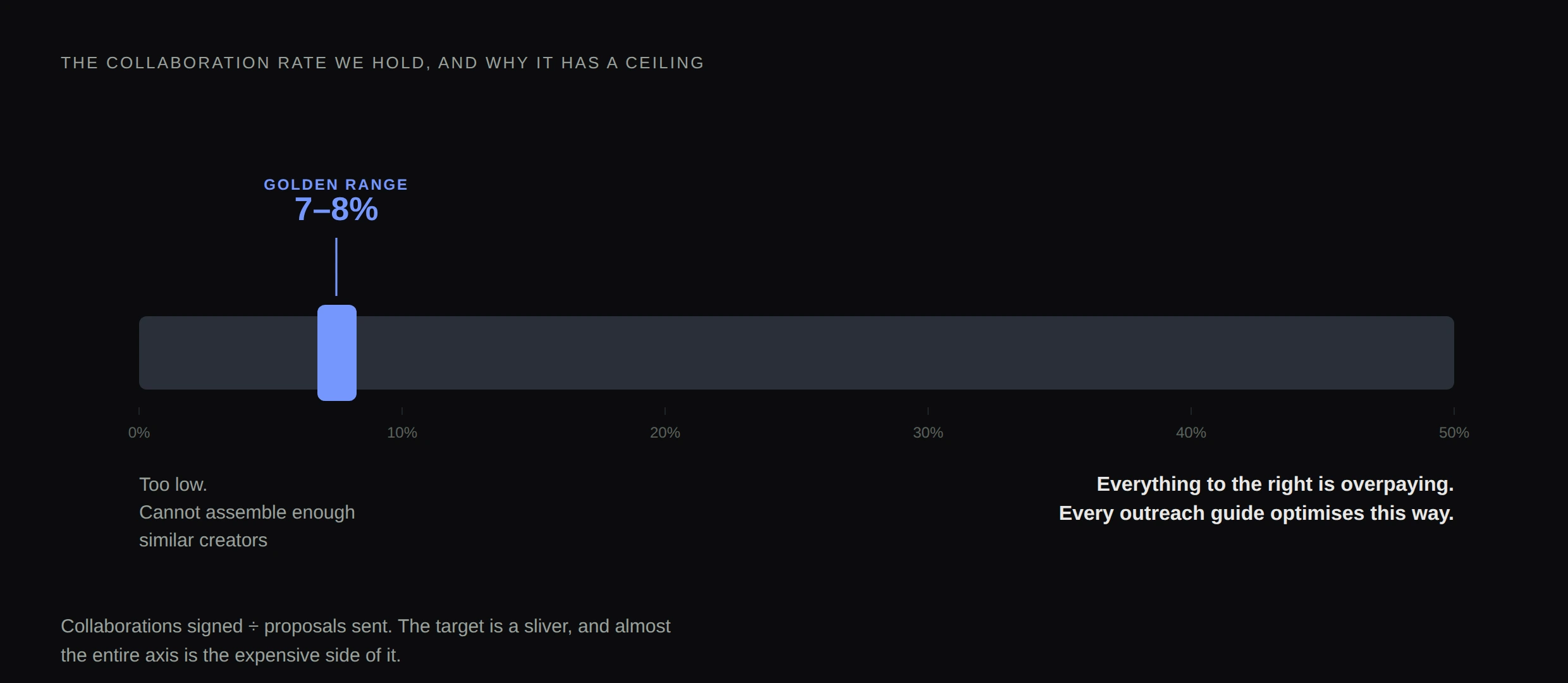
Ours sits at 7–8%. That is collaborations actually signed, divided by creators we sent a proposal to.
We arrived at the band the slow way. Over more than two years and a large number of campaigns we measured where the rate landed against what we were paying, and then chose to hold this range as an operating standard. We are not claiming to have proven a mathematical optimum. We are saying that when we drift out of the band in either direction, the campaign gets worse, and we have seen that often enough to stop arguing with it.
Why does a high acceptance rate mean you overpaid?
Influencer fees are a price. If almost everyone you approach says yes, your price is above the market clearing price for that creator, that country, and that product.
Marketing is the business of efficiency — ROI, ROAS, CPM. Buying the same reach at a higher unit cost is not a better campaign, it is a worse one that feels good. A brand paying for 50% acceptance is paying for the comfort of a full calendar.
This is also why "just pay more" is not an answer to a low acceptance rate, even though it always works. It works the way lowering your price always sells more product. The question was never whether you can buy acceptance. It is what acceptance costs, and whether that is the cheapest way to buy the reach.
Is reply rate the same as acceptance rate?
Published benchmarks are usually measuring something else, and the numbers are not comparable. The guides you will find promise 40% or better reply rates or explain how to improve response rates. A reply is someone answering your message. A collaboration is someone shipping content under contract. Those are different denominators and different events.
So we are not claiming our 7–8% beats anyone's 40%. We are making a different argument: the direction of the whole conversation is wrong. Every piece of advice in this category assumes higher is better and optimises for it. On the metric that costs money, higher is a warning.
Why do creators decline, and is it really the money?
The industry talks about acceptance as though it were a price function. In practice most declines have nothing to do with the fee.
Timing is the most common reason by a wide margin — the creator is mid-contract with someone else, travelling, or simply full that month. After that it is the product itself, or the brand's positioning, or something entirely outside your model. We have had creators pass because the product reminded them of an ex.
You cannot price your way past most of that, and trying to means paying a premium to the majority who would have said yes anyway, in order to convert a minority who were never a pricing problem.
What actually sets the right fee?
Four things, and none of them is your budget.
| What moves the fee | |
|---|---|
| Country | Income levels and social media penetration. A creator's expected rate follows their local market |
| Brand | Awareness and affinity in the target country. A luxury house can seed a five-dollar tote easily, because creators want the association |
| Product | Desirable, expensive, or nice-to-have products lower the fee. High-involvement categories raise it |
| Creator scarcity | The narrower the persona pool, the higher the rate. This is ordinary supply and demand |
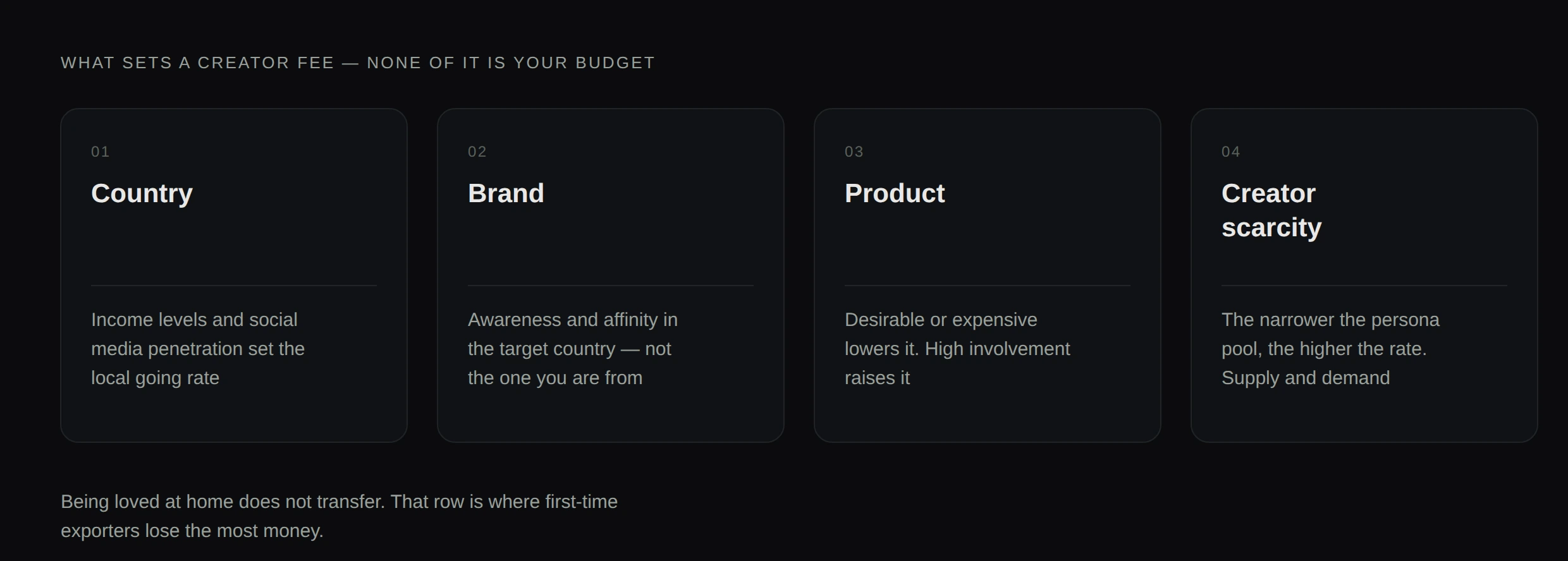
The brand row is where new exporters lose money. Being loved at home does not transfer. A brand with strong domestic recognition often prices its first overseas campaign as though creators there already know it, and they do not.
Why do skincare and colour cosmetics price differently?
This one we did not expect. Take one brand, two products at a similar price, one skincare and one colour. Skincare reaches a comparable acceptance rate at a noticeably lower fee. Colour cosmetics need more.
The reason seems to be involvement. Skincare is closer to a more-is-better category — another good serum is welcome. Colour is personal: shade, finish, and skin tone make it a matter of individual taste, so a creator is agreeing to be seen using that specific thing.
We would not push this further than an observation from our own campaigns. But it is worth sitting with, because skincare already carries the better cost structure on the manufacturing side. A category that is cheaper to make and cheaper to seed may explain more of the last few years than most people credit.
Why does a narrow persona cost more?
Say you are seeding sunscreen. Cyclists, scuba divers, and tennis players are all defensible targets and all price differently, because the pool of creators who genuinely fit each one is a different size.
Mega influencer fees are not high because their content is better. They are high because there are very few of them. The same arithmetic runs all the way down.
Why is a creator fee just a channel cost?
Once you see it that way the decision gets simpler. A creator fee buys distribution, the same as any other media line. You want the cheapest efficient channel, not the most agreeable one.
And you compare across countries, products, and campaign waves — which is impossible unless campaigns are named consistently from the first proposal. Our UTM builder enforces a convention; without one, the comparison that would tell you whether your fees are right never gets made.
Why do we not push it lower either?
Below the band a different problem starts. Viral seeding depends on assembling enough creators who are demonstrably similar to one another, so the platform reads the batch as one cluster rather than scattered posts — the mechanism we described in the four types of influencer marketing.
Under-price the proposal and you cannot fill that set. You get whoever happened to say yes, which is not the same thing as the creators you needed. The cluster thins, the similarity weakens, and the campaign loses the only advantage it had.
That is why the range has a floor as well as a ceiling. Too high and you are buying agreement. Too low and you cannot buy the shape.
Questions people ask
What is a good influencer acceptance rate?
We hold ours between 7% and 8%, measured as collaborations signed divided by creators we sent a proposal to. We arrived at that band over more than two years of campaigns and treat it as an operating standard rather than a proven optimum.
Is a high influencer acceptance rate good?
No. If most creators you approach accept, your fee is above the market rate for that creator, country and product. You are buying the same reach at a higher unit cost, which is a worse campaign that simply feels better.
Is reply rate the same as acceptance rate?
No, and published benchmarks usually measure replies. A reply is someone answering your message. A collaboration is someone shipping content under contract. The denominators differ, so a 40% reply rate and a 7% acceptance rate are not comparable numbers.
What determines how much to pay an influencer?
Four things: the target country's income levels and social media penetration, brand awareness in that country rather than at home, the product category and how high-involvement it is, and how scarce the creator persona you need actually is.
FOR YOUR BRAND · INDENT
Ready for your brand’s next market?
Looking for creators and a campaign that fit your brand? Talk to Indent about global influencer marketing.
Sources
- Influencer Hero — Achieve 40%+ Reply Rates with Our Top 5 Influencer Outreach Rulesinfluencer-hero.com · checked 2026-08-18
- Later Influence — Creator Recruitment & Outreach: Best Practices on Improving Response Rateshelp-influence.later.com · checked 2026-08-18