 Seldon
The odds of a million-view video, from 25,613 posts
Last updated
#million-view video#seeding#viral content#recommendation system#hero#breakout#COSRX
Clients ask this more often than anything else: how many pieces do we have to seed before one of them passes a million views? We ran it on our own campaigns. The answer is one in 328. That number is accurate, and taken at face value it will lead you to plan the wrong thing.
How many seeded pieces does a million-view video take?
We randomly sampled seeding campaigns we ran and looked at the 25,613 pieces of content inside them. Seventy-eight passed a million views. That is 0.305%, or one in 328.
So seed about three hundred pieces and the expected number of million-view videos is one. That is what the arithmetic says, and it is the answer most people want.
Why does that number mislead?
Because it treats every piece as an independent draw, and seeding is designed to break exactly that assumption.
Viral content marketing works by making pieces resemble one another closely enough that the recommendation system reads them as a trend and lifts the whole cluster rather than any single video. We covered the mechanism in the four types of influencer marketing. When it works it does not hand you one million-view video. It hands you several in the same week. When it does not work, the campaign produces none.
Outcomes are not spread evenly across 328-piece increments. They are clumped. The academic work most seeding advice still rests on measured whom you seed to; this is about something the same study held fixed. This is also why the averages in our cost-per-view data sit twenty-three times above the medians — the tail is not made of scattered lucky pieces, it is made of a few campaigns that broke out all at once.
Why do the two questions give very different numbers?
Once you see the clumping, the original question splits.
| Number | Basis | |
|---|---|---|
| Odds a given piece passes a million views | 0.305% — one in 328 | Measured. 25,613 pieces, 78 hits |
| Odds a campaign breaks out as a whole | Far lower than 0.305% | Not measured here. Illustrated below |
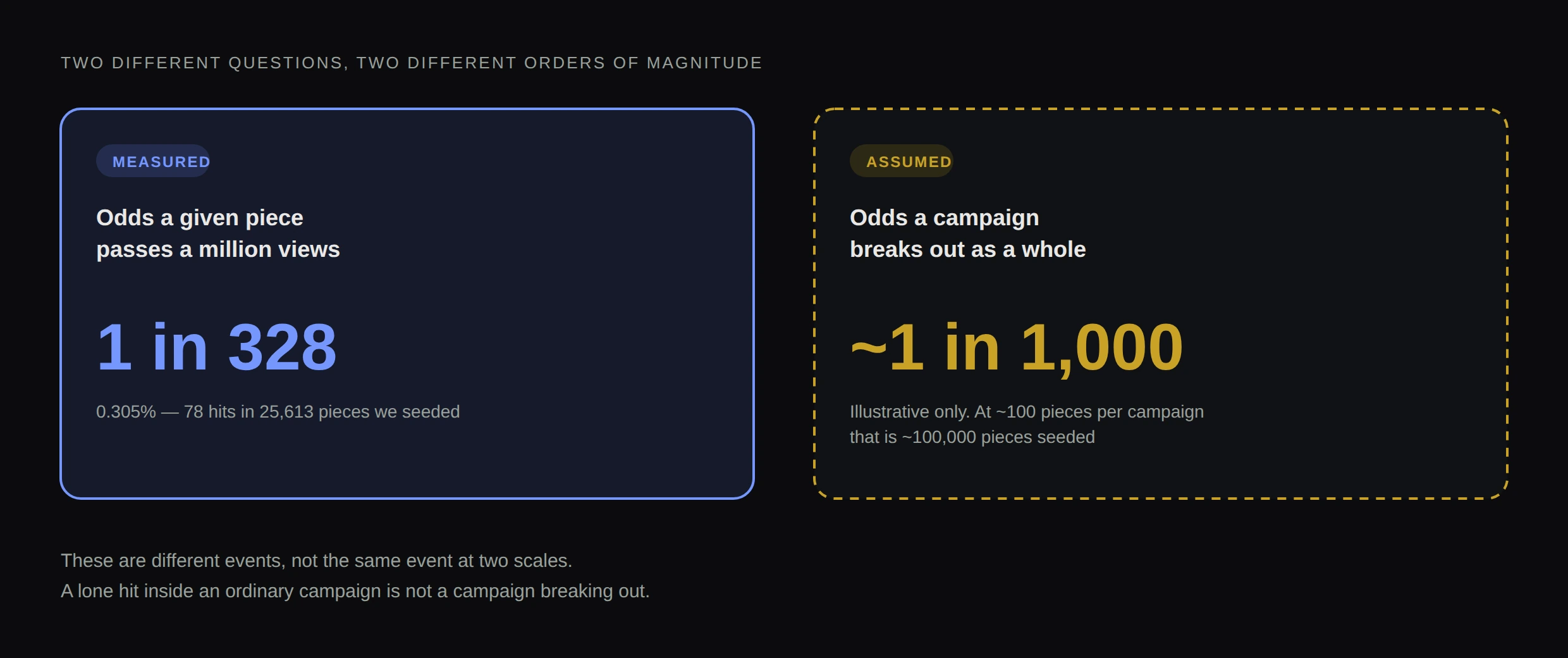
Take the second one and put an illustrative figure on it. Say a campaign breaks out wholesale one time in a thousand. Our seeding campaigns carry anywhere from 30 to 300 pieces, so call it a hundred. A thousand campaigns at a hundred pieces each is a hundred thousand pieces seeded to engineer one deliberate breakout.
That 0.1% is an assumption, not a measurement. Change it and the answer moves by an order of magnitude. It is there to show the shape of the problem, not to be quoted as a benchmark.
The two rows do not contradict each other, and it is worth being precise about why. A single million-view piece inside an otherwise ordinary campaign and a campaign that breaks out wholesale are different events. The first is common enough to happen once every few hundred pieces. The second is what you are actually buying when you plan a viral campaign, and it is much rarer.
What happens when a campaign does break out?
You get several million-view pieces rather than one, and one of them usually runs far ahead of the rest. We call that the hero. The publicly documented version of this is COSRX, which reported 100 million views in a month off a single campaign — not one video carrying the number, but a cluster.
Most marketers treat the hero as the finish line. The campaign worked, the report looks good, everyone moves on. That is the single most expensive mistake in this discipline, because the hero is not a result. It is information about what the audience just decided it wanted, and that information has a shelf life measured in days.
Why is the hero a starting gun rather than a finish line?
The moment a hero appears you know two things you did not know a week earlier: which creative frame the algorithm is currently rewarding, and which creator profile it is rewarding it on. Both are perishable.
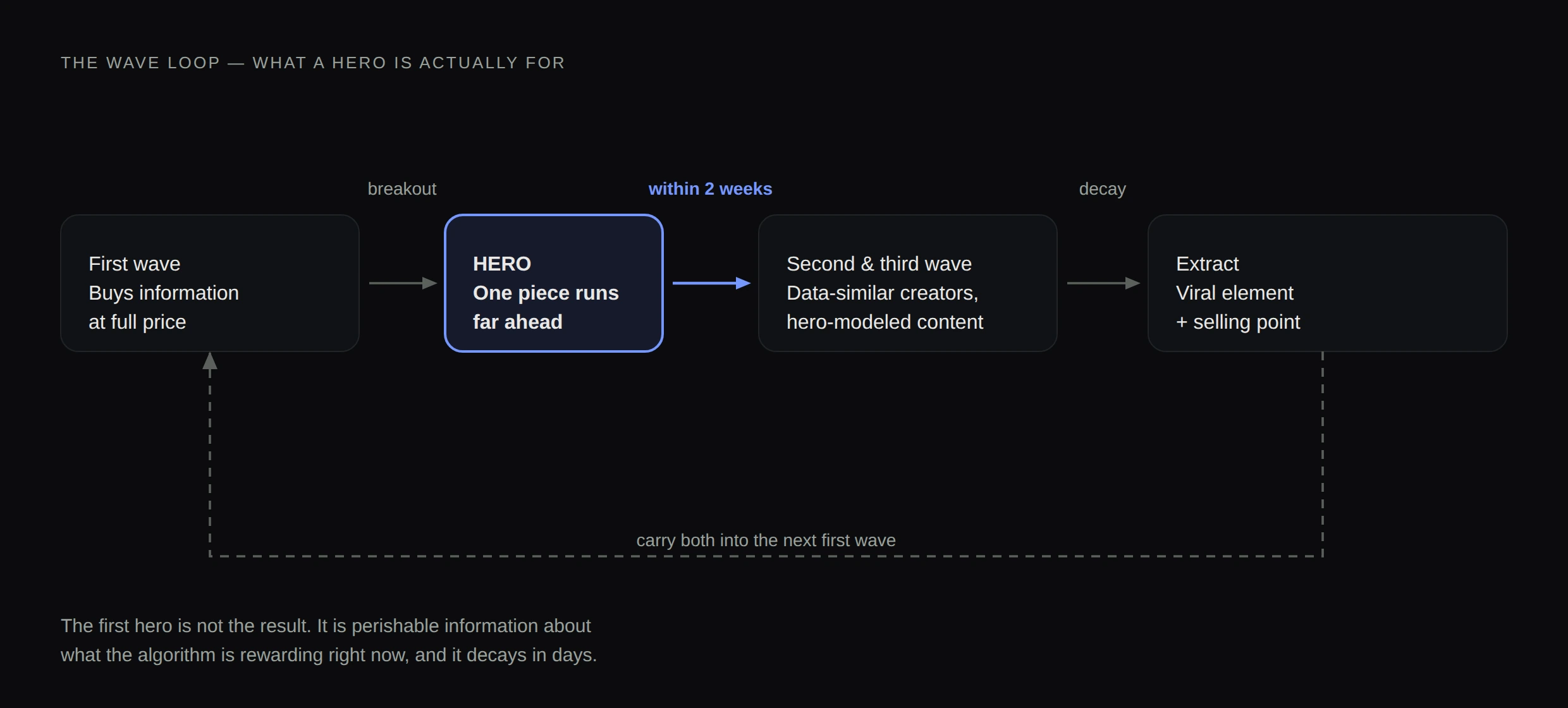
So you move. Contract quickly with a large set of creators who are demonstrably similar to the hero's creator in the platform data, and produce a volume of content closely modeled on the hero. Inside two weeks. After that the signal decays and you are seeding into a trend the platform has already discounted.
Second and third wave
We call these the second and third wave campaigns, and they are where the economics of seeding actually turn. The first wave buys information at full price. The later waves spend against a frame that is already proven, on creators already shown to carry it.
They also produce heroes of their own. More than once we have seen a second or third wave produce a piece that dwarfs the original hero — which makes sense, because by then you are no longer guessing at the frame.
What do you do when the virality dies?
It always dies. A frame that everyone is reproducing stops being a signal and becomes noise, and the platform learns to discount it.
When that happens the job is to extract two things before moving on. First, the viral element — the specific thing inside the creative plan that made people stop, not the topic but the mechanic. Second, if the campaign moved product, the selling point that actually converted, which is often not the one the brand leads with.
Those two carry forward into the next first-wave campaign. That is the loop, and running it is what separates a marketer who caught a viral from one who can produce them.
What does this change about planning?
Three things change if you accept the clumping.
Stop budgeting for a million-view video and start budgeting for a number of attempts at a breakout. A single campaign of three hundred pieces is one attempt, not three hundred lottery tickets.
Reserve budget for the second wave before the first wave launches. If the reserve has to be approved after a hero appears, the two-week window closes during the approval.
And decide the tagging convention before the first piece goes live. You cannot tell a first-wave piece from a second-wave piece afterwards, which means you cannot tell whether the waves are working — our UTM builder enforces one, and at this volume nothing survives that is not enforced.
Questions people ask
How many pieces do you have to seed to get a million-view video?
In our sample, 78 of 25,613 seeded pieces passed a million views, which is 0.305% or one in 328. That figure is accurate per piece, but seeding outcomes cluster by campaign rather than spreading evenly, so planning around 328 pieces misreads the problem.
Why do viral results cluster instead of spreading out?
Because seeding is built to make pieces resemble one another so the recommendation system reads them as one trend and lifts the cluster. When it works a campaign yields several million-view pieces in the same week. When it does not, that campaign yields none.
What is a hero piece in a seeding campaign?
The hero is the single piece that runs far ahead of the rest when a campaign breaks out. It is not the result of the campaign. It is perishable information about which creative frame and which creator profile the algorithm is currently rewarding.
What should a brand do after a piece goes viral?
Within two weeks, contract creators who are demonstrably similar to the hero's creator in the platform data and produce content closely modeled on the hero. We call these second and third wave campaigns, and they often produce a hero larger than the first.
FOR YOUR BRAND · INDENT
Ready for your brand’s next market?
Looking for creators and a campaign that fit your brand? Talk to Indent about global influencer marketing.
Sources
- COSRX #SnailDuoShot TikTok Challenge Scores 100 Million Views in a Monthprnewswire.com · checked 2026-08-16
- Hinz, Skiera, Barrot & Becker — Seeding Strategies for Viral Marketing, Journal of Marketing (2011)journals.sagepub.com · checked 2026-08-16