 Seldon
Four types of influencer marketing, and which one scales
Last updated
#influencer marketing#types of influencer marketing#viral content marketing#paid placement#authentic content#affiliate marketing#seeding
Every guide to influencer marketing sorts campaigns by how you pay for them: gifted, paid, affiliate. That axis is easy to write and close to useless when you are planning, because payment terms tell you nothing about whether a campaign can grow. Sort by what actually produces the reach and you get four types instead — and only one of them has no ceiling.
I have spent nineteen years in commerce and the last several watching brands try to buy their way into new markets. The ones that break out are rarely the ones that spent the most. They are the ones that knew which of these four they were running.
What are the four types of influencer marketing?
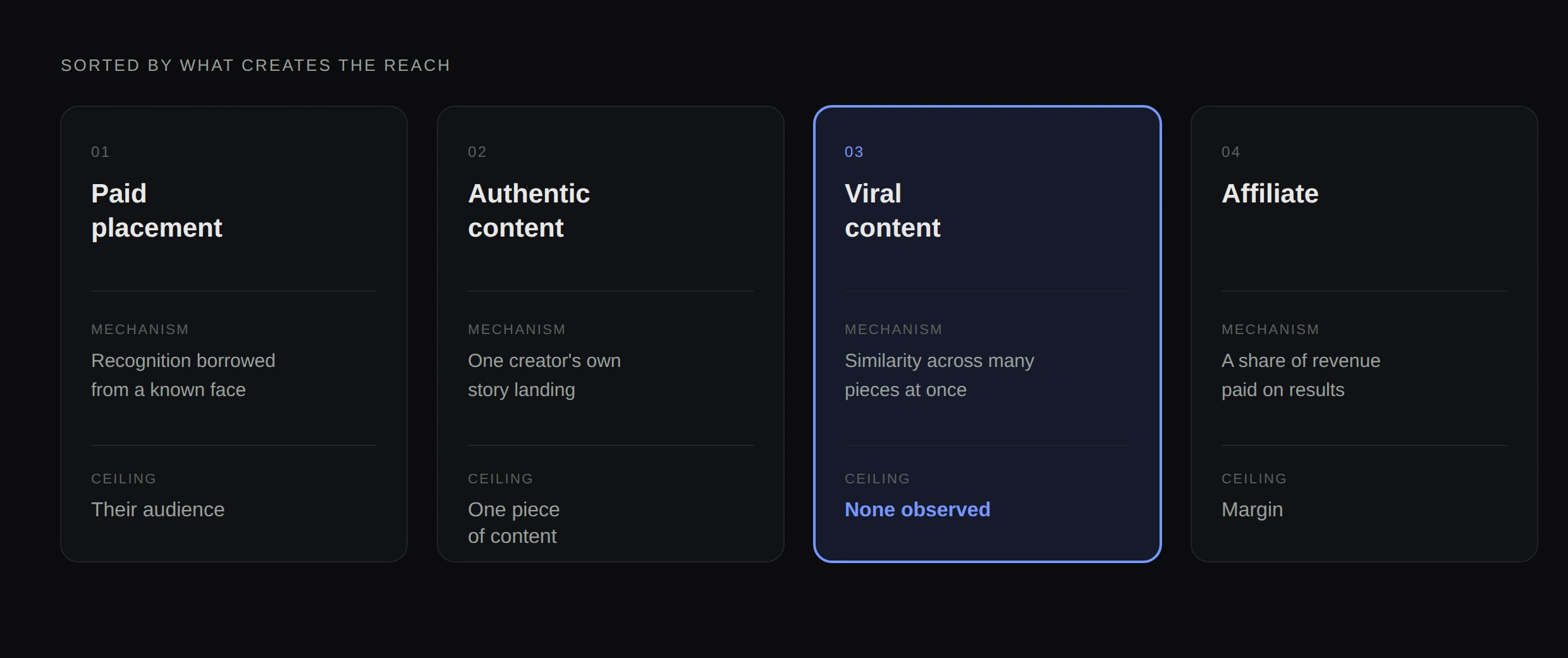
There are four: paid placement, authentic content, viral content, and affiliate. What separates them is not the contract but the mechanism that creates reach — borrowed recognition, one creator's story, similarity between many pieces of content, and a share of revenue.
| Type | What creates the reach | Who decides the outcome | Ceiling |
|---|---|---|---|
| Paid placement | Recognition you borrow from a known face | The celebrity's existing image | Their audience |
| Authentic content | One creator's own story landing | The creator | One piece of content |
| Viral content | Similarity across many pieces at once | The planner | None observed |
| Affiliate | A share of revenue paid on results | The creator's selling ability | Margin |
The lines are not clean. Most working programs run two or three of these at once, and the industry uses the words loosely. That is fine for conversation and expensive when you are the one deciding where the budget goes.
Why classify by mechanism, not by how you pay?
Because payment terms do not predict scale. Two campaigns can both be "gifted" and one stops at a few hundred thousand views while the other keeps compounding for months. The difference is never the gifting.
Here is the part that matters for hiring and for planning. In three of these four types, the outcome sits with the creator — how famous they are, how well they tell a story, how convincingly they sell. You can brief them, but you cannot be them. In one type, the outcome sits with the planner. That is a different business with different people in it, and no amount of budget substitutes for the skill.
What is paid placement actually for?
Paid placement buys a borrowed image. You pay a celebrity or a mega-influencer so that the feeling people already carry about them transfers onto your product. It is a shortcut through a door that is already open in someone's head.
You get two things. The association, which is the real purchase. And the surface — the traffic that passes through their posts, stories and short-form feeds.
What you rarely get is payback. A single placement almost never clears its own cost, and brands that expect ROAS from it are usually disappointed. Most treat it as a loss taken deliberately, the way you treat a store on an expensive street.
That calculation has changed, though. The placement is now worth more as raw material than as media. When BLACKPINK's Jisoo and Jennie each showed a gua sha tool in "what's in my bag" content, the tool itself reached a fixed audience once. What followed was the actual campaign: micro and nano creators citing, reacting to and rebuilding that moment across thousands of pieces of content. The device in question was ReFa, a Japanese brand from MTG that Koreatech brought into Korea under an exclusive import deal and has since sold more than a million units locally. The placement was the seed. The seeding was the campaign.
What is authentic content marketing?
Authentic content is a bet that one piece will break out on the strength of a creator's own story. Not a template, not a brief — the specific thing that only that person can say about your product.
Brands use it two ways. Sometimes for its own sake, because a genuinely personal piece converts better than anything a marketing team can write. More often, and more usefully, as research: you are looking for the frame that works before you spend money repeating it.
Its weakness is exactly what makes it good. It does not replicate. Hand the same brief to ten other creators and you get ten weaker versions, because the thing that made it work was not the brief.
Chef and Cooker: where a viral frame comes from
We call the creator who invents the frame a Chef, and the creators who reproduce it Cookers. A Chef makes something that had not existed — an angle, a hook, a way of showing the product that stops the scroll. Cookers take that structure and make it again, at volume, with their own faces and audiences.
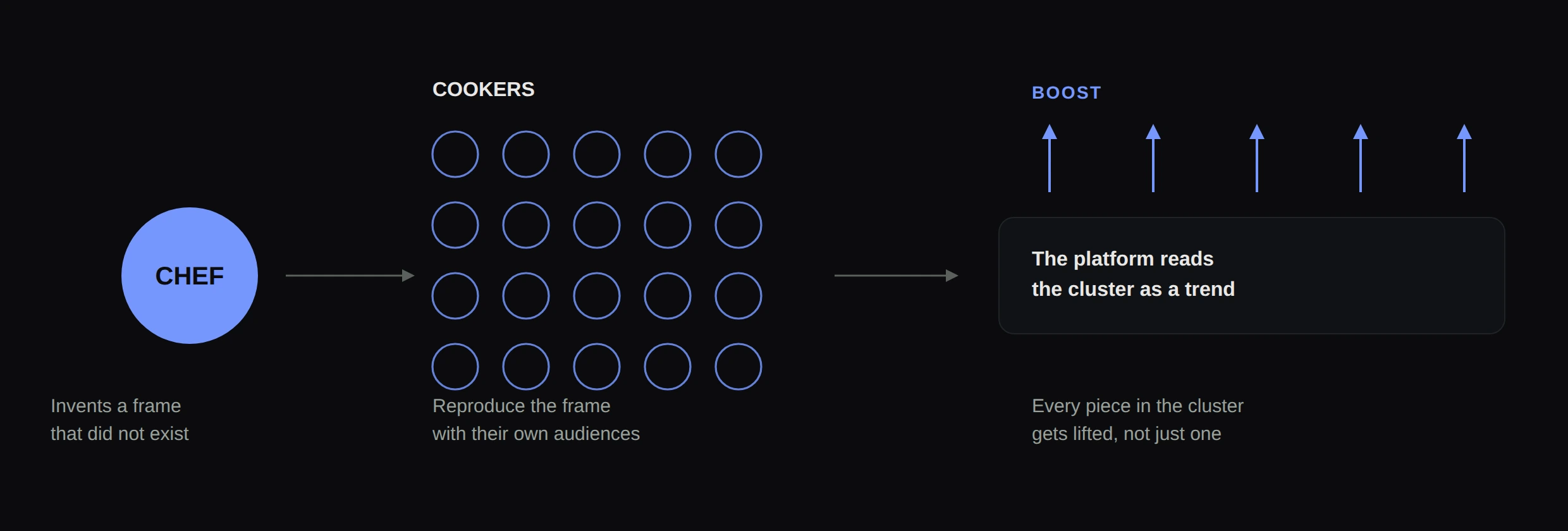
Both roles are necessary and they are not interchangeable. Before the frame exists, one Chef is worth a hundred Cookers. After it exists, the ratio inverts — and most brands get the sequence backwards, buying volume before they have anything worth repeating.
What is viral content marketing?
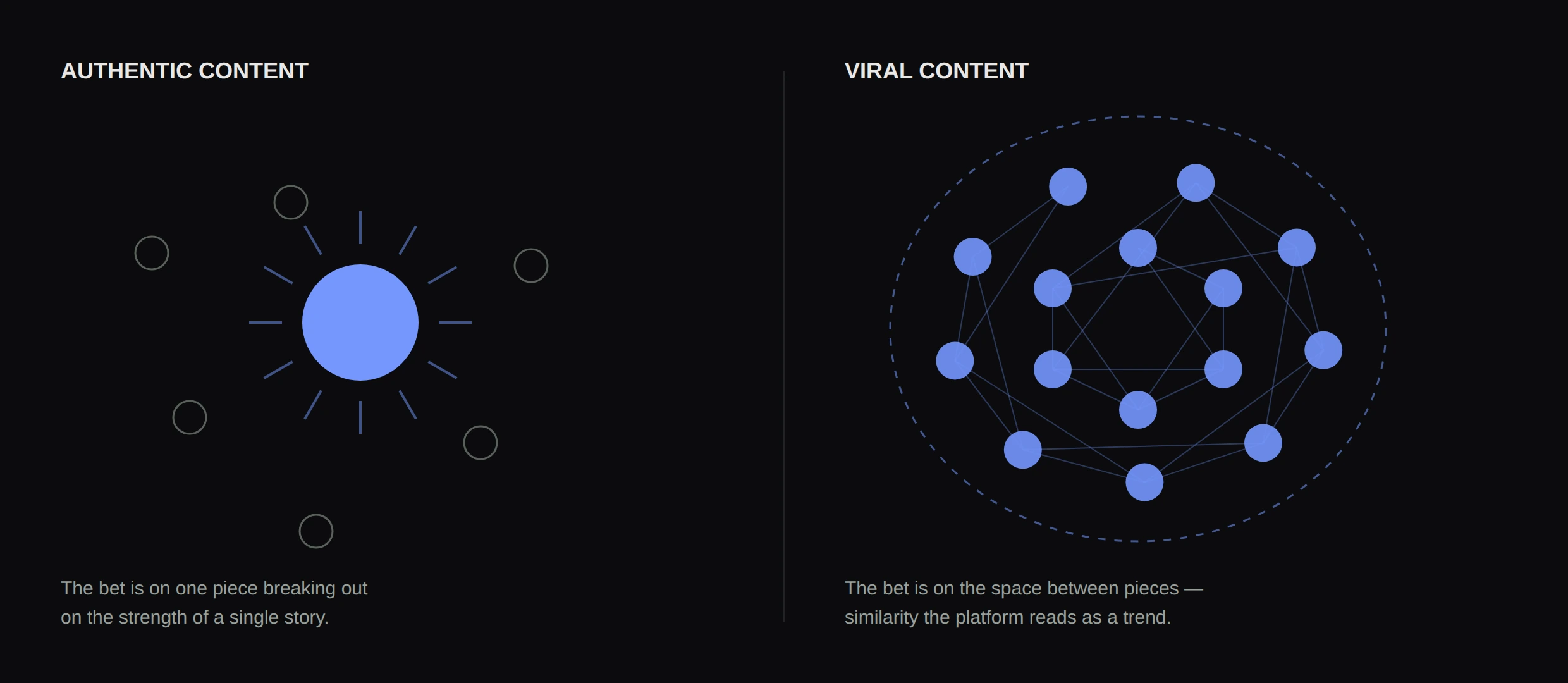
Viral content marketing engineers similarity across many pieces of content so that the platform reads them as a trend and lifts all of them. Authentic content bets on a piece. Viral content bets on the space between pieces.
The method is mechanical once you see it. Cluster creators whose audiences overlap — people who like one tend to like the others. Brief them on the same frame. Publish close enough together that the recommendation system sees a cluster rather than a scatter. The platform's job is to detect what is spreading, and a dense enough cluster looks exactly like something spreading.
The case the industry keeps coming back to is COSRX. In January 2023 the brand reported that its #SnailDuoShot challenge passed 100 million views in a month, with the #COSRX tag reaching 1.1 billion views, up 459% from the start of that year.
Those numbers get quoted often. The part that gets missed is why it worked. The challenge did not break out because it was a well-designed challenge — plenty of well-designed challenges go nowhere. It broke out because it landed on top of a seeding base already thick enough for the algorithm to read as a movement. From what I saw of the market at the time, the creator count behind it was in the tens of thousands, not the few hundred a typical campaign touches. The challenge was the visible part. The base was the campaign.
Why it is the only one without an upper limit
The other three types are bounded by someone you do not control. A celebrity has a finite audience. A creator has one good story about your product. An affiliate can only sell so much before the margin stops making sense.
Similarity has no such bound. Add more creators to a cluster and the cluster reads as more of a trend, not less. This became practical two to three years ago, when the major platforms cut how much follower count weighs in distribution. Once a small account's video could out-reach a large account's video, buying audience size stopped being the efficient move and building similarity started being one.
The constraint moved to the planner. Which is good news, because planning is something you can get better at, and fame is not.
The risk is saturation. A frame that everyone reproduces stops being a signal and becomes noise, and the platform learns to discount it. Frames expire. Plan for their replacement before they do.
How does influencer affiliate marketing work?
Affiliate pays creators a share of what they sell — revenue share or profit share, through TikTok Shop, marketplace partner programs, or a brand's own scheme. It is the only one of the four where you pay for outcomes rather than for exposure.
I argued in Forbes Korea in August 2023 that Apple's tracking restrictions had made paid advertising less efficient and that performance-based creator partnerships would take that ground, beating paid media on cost per click. That turned out to be right and badly underestimated. The market that formed since is considerably larger than what I described.
Affiliate's risk is dilution. Scale it hard enough and your product shows up everywhere, discounted, described by people who have never used it. You get sales and lose the thing that made the sales possible.
It also no longer stands alone. Brands now recruit similar creators to make similar selling content on TikTok Shop — running affiliate economics inside a viral content structure. The four types are a way to think, not four separate budgets.
Which one should a brand start with?
Start with authentic content, and treat it as research rather than as a campaign. Work with a small number of creators who have a real reason to care about the product, and watch which angle survives contact with an audience. That is your frame.
Then reproduce it. Viral content is where a brand entering a new market gets its disproportionate result, because it is the only one of the four whose ceiling is set by your own planning rather than by someone else's fame. Layer affiliate underneath once the frame is proven, so the attention converts. Buy paid placement last, and buy it as seed material rather than as reach.
One practical warning. None of this is separable in a report unless the links are tagged consistently from the first day, and a program running three of these types at once produces a mess that no amount of later analysis can untangle. Decide the naming convention before the first creator posts, not after — our UTM builder enforces one, which is the only reason conventions survive contact with a campaign.
Questions people ask
What are the four types of influencer marketing?
Paid placement, authentic content, viral content and affiliate. They differ by what creates the reach: recognition borrowed from a known face, one creator's own story, similarity across many pieces of content, and a share of revenue paid on results.
What is the difference between authentic content and viral content marketing?
Authentic content bets on a single piece breaking out on the strength of one creator's story. Viral content engineers similarity across many pieces at once, so the platform reads them as a trend and lifts all of them. One bets on a piece, the other on the space between pieces.
Which type of influencer marketing scales best for ecommerce?
Viral content, because it is the only one whose ceiling is set by the planner rather than by a creator's fame. The other three are bounded by the celebrity's audience, by the strength of a single story, or by the margin left after a revenue share.
What is a Chef and a Cooker in influencer marketing?
A Chef is the creator who invents a content frame that did not exist before. Cookers are the creators who reproduce that frame at volume with their own audiences. Before the frame exists, one Chef is worth a hundred Cookers. After it exists, the ratio inverts.
FOR YOUR BRAND · INDENT
Ready for your brand’s next market?
Looking for creators and a campaign that fit your brand? Talk to Indent about global influencer marketing.
Sources
- COSRX #SnailDuoShot TikTok Challenge Scores 100 Million Views in a Monthprnewswire.com · checked 2026-08-16
- 국내 뷰티 디바이스 정복 나선 코리아테크 — MTG 독점 수입 계약thebk.co.kr · checked 2026-08-16
- '리파(ReFa)', 누적 판매 100만 대 돌파biz.heraldcorp.com · checked 2026-08-16
- 제휴마케팅과 커머스 시장의 미래 — 포브스코리아 202309호forbeskorea.co.kr · checked 2026-08-16